Best Electronic Dartboards for Automatic Scoring
Electronic dartboards score automatically and take soft tips, thrown from 96 inches rather than the steel tip 93.25 inches, with the bull at the same 68 inches from the floor. Segment sensitivity matters more than game count: below about a hundred dollars boards start missing hits. They need a lane of about 10 ft by 5 ft and a power outlet.
Electronic boards solve two real problems: nobody has to keep score, and soft tips make darts viable in a household where a stray steel point is a genuine concern. What they do not do is replace a bristle board for someone who wants to get good at darts, and being clear about which of those you want makes this an easy decision rather than a confusing one.
Hang it to the same bull height as a steel tip board, 68 inches to the centre of the bull, but set the throw line at 96 inches rather than 93.25. The layout calculator switches between the two.
Electronic boards, and the honest alternative

Arachnid CricketMaxx 1.0 Electronic Dartboard
A wide target area and a large game library at the price where electronic boards stop being frustrating. Segment sensitivity is the whole difference between a good electronic board and an annoying one, and this sits on the right side of that line. Below about a hundred dollars, boards start missing hits and inventing others.
- Tips
- Soft
- Throw
- 96 in
Best for: A family room where automatic scoring is the entire point.

Viper 850 Electronic Soft Tip Dartboard
Better segment separation and a more reliable score registration than anything cheaper, plus a deep list of games and player handicapping so an adult and a nine year old can have a real match. This is the electronic board to buy if the household is going to use it several times a week.
- Tips
- Soft
- Players
- Multi with handicaps
Best for: A family that will actually play, rather than one that plays twice a year.
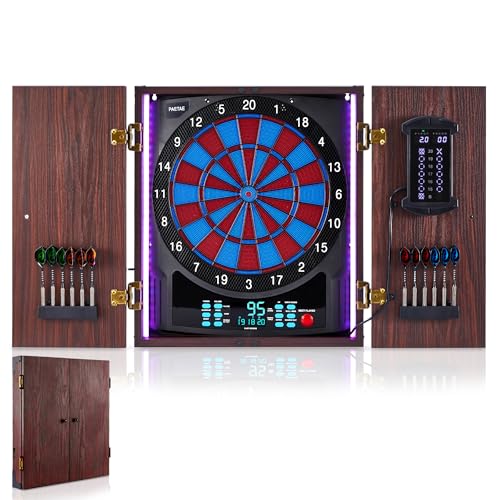
PAETAE Electronic Dartboard Cabinet Set
Electronic scoring inside a cabinet that closes, which solves the one aesthetic problem with electronic boards: they look like equipment in a way a wooden cabinet does not. In a living room or a finished basement this is the version that gets approved.
- Tips
- Soft
- Cabinet
- Wooden, closes
Best for: A room that is not only a game room.

Franklin Grade A Staple-Free Dartboard
Listed on an electronic dartboard page on purpose. If your goal is to play the game leagues and pubs play, a staple-free sisal board is what you want, and no electronic board substitutes for it. Automatic scoring is convenience; sisal is the game.
- Tips
- Steel
- Throw
- 7 ft 9.25 in
Best for: Anyone whose real goal is to get good at darts.
Prices move constantly, so confirm before you order. As an Amazon Associate we earn from qualifying purchases. Where a table is sold only through a manufacturer's own dealer network we say so on the card, and the button searches comparable tables you can order today rather than that exact model.
Soft tip against steel tip, by the numbers
| Measurement | Steel tip, sisal | Soft tip, electronic |
|---|---|---|
| Bull height | 68" (5 ft 8 in) | 68" (5 ft 8 in) |
| Throw line | 93.25" (7 ft 9.25 in) | 96" (8 ft) |
| Minimum lane length | 9 ft 9 in | 10 ft |
| Dart weight, typical | 20 to 26 g | 16 to 20 g |
| Scoring | By hand, or a dry erase board | Automatic |
| Power required | No | Yes, mains adaptor |
| Bounce-outs | Wire dependent, fewer on staple-free | Common, and they cost you the score |
| Transfers to a pub board | Yes, it is the same game | Partly, different line and flight |
The specification that decides everything: segment sensitivity
An electronic board registers a hit by physical movement of a segment, so a dart that lands on a wire divider or barely penetrates may not register at all. On cheap boards the segments are larger and stiffer and this happens constantly, which is the single biggest source of frustration with the format and the reason so many electronic boards end up in garages.
Spending above roughly a hundred dollars buys smaller segments, better separation and more reliable registration. Prioritise that over the number of games printed on the box: nobody plays more than five or six of the forty games any board claims, and everybody notices a board that scores a treble twenty as a single.
Never throw steel tips at an electronic board. The points punch through the plastic segments and damage the sensor matrix behind them, and no electronic board is rated for it. If you want both games, the correct answer is two boards, which is what the cabinet sets that include both are for.
When an electronic board is the right answer
- Young children in the house. Soft tips are genuinely safer, and player handicapping lets a six year old and an adult play a real game against each other. This is the strongest case and it is a good one. The family buildout is built around this logic.
- A rented room. Soft tips do far less damage to a wall than steel points, and a surround plus an electronic board is close to risk free.
- Nobody wants to keep score. A legitimate reason. Cricket in particular is tedious to score by hand and delightful when the board does it.
- Mixed ability groups. Handicapping is the feature that keeps a game interesting when one player is much better, and no bristle board offers it.
When to buy sisal instead
- You want to get better at darts. League and pub darts is steel tip on sisal from 93.25 inches. Practice on soft tip from 96 inches with lighter darts does not transfer cleanly, and you will notice the first time you play somewhere else. Buy the staple-free sisal board and a set of tungsten darts .
- You want the board to be quiet. Electronic boards beep, announce scores and play sounds. Some can be muted, none are silent, and it matters more in a shared home than people expect.
- You do not want another thing to plug in. A sisal board needs a nail. An electronic board needs an outlet within cable reach of the exact spot on the wall where the board has to hang, which constrains the layout more than it sounds.
What to buy alongside
A throw line, because 8 ft by eye is never 8 ft: a peel-and-stick oche or a laser line . Spare soft tip darts in a nine pack, because plastic tips break and get lost at a rate steel points do not. And a surround if the board is going on painted drywall, since bounce-outs are more common with soft tip than steel.
The full comparison is in bristle against electronic, the sisal options are in the dartboard roundup, and the layout numbers are in the regulation chart.
Frequently asked questions
Are electronic dartboards any good?
They are good at a specific job: automatic scoring, soft tips, and a large library of games with handicapping so players of very different standards can have a real match. They are not a substitute for a bristle board if the goal is to get better at darts, because soft tip throws from a longer line, plastic tips fly differently, and the segment geometry is not identical. Choose on what you want from the room rather than on which is better in the abstract.
What is the throw line distance for an electronic dartboard?
96 inches, which is 8 ft exactly, measured horizontally from the face of the board to the back edge of the line. That is 2.75 inches further back than the steel tip line of 93.25 inches. The bullseye height is identical at 68 inches from the finished floor. The extra distance is why practice on one board does not transfer cleanly to the other.
Why do electronic dartboards miss scores?
Because the segments register a hit by physical movement, and a dart that lands on a wire divider or that only just penetrates a segment may not push it far enough. Cheap boards have larger, less sensitive segments and this happens constantly, which is the single biggest source of frustration with the format. Spending above roughly a hundred dollars buys smaller segments and better registration, and it is the specification to prioritise over the game count.
Can you use steel tip darts on an electronic dartboard?
No, and it will destroy the board quickly. Steel tips punch through the plastic segments and damage the sensor matrix behind them, and no electronic board is rated for it. Some cabinet sets ship with both a bristle board and an electronic board precisely so that both games are available, which is a better solution than trying to make one board do both.
How much space does an electronic dartboard need?
A lane of about 10 ft long by 5 ft wide, which is very slightly more length than a steel tip setup because the throw line is 2.75 inches further back. It also wants around 7 ft 6 in of ceiling and a power outlet within reach, which is the one requirement steel tip does not have and which decides where on a wall the board can go.
Do electronic dartboards need batteries or mains power?
Most run on mains power through an adaptor, and some also accept batteries. In practice you want mains, because a scoring board that dies mid-game is worse than no scoring at all. Plan the outlet position before you hang the board rather than after, since a cable running diagonally across a wall is both ugly and something a stray dart will eventually find.
Measuring your own room before anything is delivered? The Game Room Layout Planner is the paid version of these pages: 8 printable worksheets you fill in with your own numbers, plus the full PDF, $29.
How we work: we compare published manufacturer dimensions, the governing playing standards for each game, and reviews from owners who live with the equipment. We do not test games in person, and we say so on every page. Clearance figures here are researched guidance for planning a room, not professional advice: measure your own space, and have a slate table delivered, assembled and levelled by an installer rather than moving it yourself.