Best Foosball Tables: Rods Decide Everything
Buy a foosball table with solid steel rods and counterbalanced men, which is what separates a real table from a toy and costs roughly two hundred dollars more. A standard 56 in table needs a room of 6 ft 10 in by 10 ft 8 in, and the constraint is width rather than length because the rods slide out of the long sides as they are spun.
Foosball is the largest genuinely serious game that fits a small room, because the players stand still rather than walking a perimeter. It is also the game with the clearest quality threshold in the whole hobby: two specifications separate a table you will play for twenty years from one that ends up in a garage, and both are about the rods.
The measurement people get wrong: width is the constraint. The rods come out of the long sides and slide as they spin, so a player at the side needs 26 inches of room for the rod to travel past them. Measuring only the cabinet footprint is how people end up with a table they cannot stand at. Check yours with the foosball clearance calculator.
Foosball tables from family to tournament
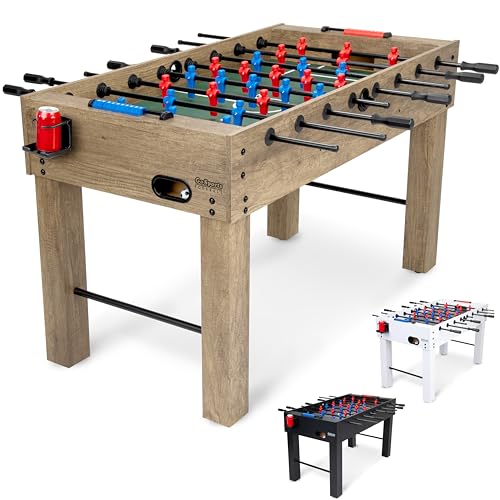
GoSports 54in Full Size Foosball Table
A full size 54 in table at the price where foosball stops being a toy. The rods are the compromise at this price, and knowing that is the point: it plays fine for a family and it will flex under a hard shot in a way a tournament table does not.
Needs 6 ft 10 in x 10 ft 8 in
- Size
- 54 in
- Rods
- Standard
Best for: A family room, or a first table where the budget is elsewhere.

Barrington Richmond 58in Foosball Table
Fifty eight inches in a heavier cabinet with proper levellers, which matters more than it sounds on an uneven basement floor: a foosball table out of level rolls the ball to one side on every restart.
Needs 6 ft 10 in x 10 ft 8 in
- Size
- 58 in
- Levellers
- Adjustable
Best for: A family room on a floor that is not flat.

Hathaway Primo 56in Foosball Table
Solid steel rods with counterbalanced men, which is the specification that separates a real foosball table from a toy. Counterbalanced means the figures stay where you leave them instead of flopping down over the ball, and that single detail changes how the game is played.
Needs 6 ft 10 in x 10 ft 8 in
- Size
- 56 in
- Men
- Counterbalanced
Best for: The default home table for anyone who will play properly.

KICK Titan 55in Tournament Foosball Table
A tournament-specification table at roughly half what the American competition standards cost. Heavy cabinet, proper bearings and the rod feel that lets you pull off a pull shot rather than merely hitting the ball hard.
Needs 6 ft 10 in x 10 ft 8 in
- Size
- 55 in
- Build
- Tournament
Best for: Someone who has played on a good table and wants one at home.
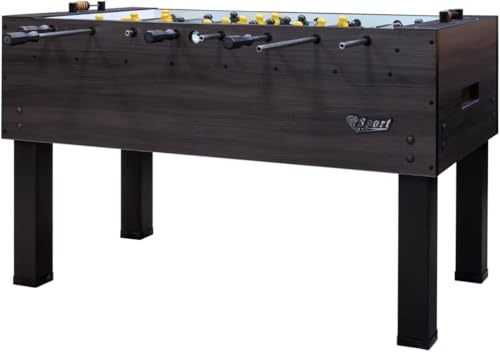
Tornado Sport II Foosball Table
Tornado is what American tournament foosball is played on, and the Sport II is the entry point into that lineage. Solid one-piece men, a level playfield and a rod feel that nothing cheaper replicates. This is a lifetime table.
Needs 6 ft 10 in x 10 ft 8 in
- Build
- Made in the USA
- Class
- Tournament
Best for: A dedicated game room and a player who is serious about the game.

Tornado Tournament 3000 Foosball Table
The full competition table, and the one tournaments actually run on. Genuinely more than a home room needs and genuinely better, with a cabinet built to survive commercial use. Buy this only if you already know why you want it.
Needs 6 ft 10 in x 10 ft 8 in
- Class
- Tournament 3000
- Build
- Commercial
Best for: A serious player or a room that hosts competition.
Prices move constantly, so confirm before you order. As an Amazon Associate we earn from qualifying purchases. Where a table is sold only through a manufacturer's own dealer network we say so on the card, and the button searches comparable tables you can order today rather than that exact model.
The room it needs, and the mistake people make
| Measurement | Figure | Why |
|---|---|---|
| Cabinet footprint | 30" x 56" | What the listing tells you, and only half the story. |
| Side clearance, each side | 26" | Rod travel plus the player standing behind it. |
| End clearance, each end | 36" | Walking room and ball retrieval only. |
| Room needed | 6 ft 10 in x 10 ft 8 in | Width first, which is the opposite of what people assume. |
The rods stick out of the LONG sides and travel as they spin, so side clearance is the real constraint here, not length.
The two specifications that decide a table
Solid rods against hollow rods
A solid steel rod transmits what your wrist does straight to the figure. A hollow rod, which is what almost every table under about three hundred dollars uses, flexes under a hard shot, and the flex is felt as a delay between the input and the result. That vagueness is why cheap tables feel like a different game: not because the ball is different but because you cannot place a shot precisely.
Hollow rods have one genuine advantage, which is weight: a table full of solid steel rods is heavier and the rods take slightly more effort to move quickly. Serious players almost all prefer solid anyway, and telescoping safety rods, which do not pass through the far side of the cabinet, are a legitimate choice in a household with small children.
Counterbalanced men
A counterbalanced figure is weighted so that it stays wherever you leave it rather than swinging down under gravity. That sounds cosmetic and it is not: it means you can leave a rod tilted back and ready, which is the basis of most of the technique in the game. On a table without it, every figure hangs vertically over the playfield and blocks the ball, and the game becomes a scramble.
Roughly two hundred dollars separates a table with solid counterbalanced rods from one without. It is the single best value step available anywhere in this hobby, and it is why the useful price floor for foosball is around five hundred dollars rather than two hundred.
The other things worth checking
- Bearings. Nylon or bronze bushings on a home table, sealed bearings on a tournament one. Bearings are what make a rod spin smoothly for a decade rather than getting gritty in a year.
- Cabinet weight and thickness. Foosball is played by people leaning and pulling hard on the rods. A light cabinet walks across the floor during a serious game, which is both annoying and a sign that the playfield is flexing.
- Levellers on every leg. Not optional on a basement floor. A table out of level rolls the ball to one side on every restart and quietly makes one player's goal easier.
- Playfield surface. A smooth laminate with a printed field that will not wear through. The ball should roll true across the whole surface, and a dip in the middle is a sign of a substrate that has already sagged.
- One goalie or three. American tables use a single goalkeeper, European tables often use three. A preference rather than a quality marker, but worth knowing which you learned on.
Levelling, which is the most common complaint
- Put the table where it will live, on the final floor covering.
- Place a ball in the centre of the playfield and let go. Do not use a spirit level: the ball is the instrument, because the ball is what plays.
- Raise the leg the ball rolls away from, in small increments, re-testing after each one.
- Repeat at four points on the playfield, not only the centre, because a sagged substrate shows up at the edges rather than the middle.
- Re-check if the table is moved, including moved a few inches to vacuum behind it.
Where foosball fits
In a small room it is the best anchor game available, which is why it is the centrepiece of the small room buildout. In a family room it competes with air hockey and loses slightly on age, because foosball needs enough height and coordination to reach and control the rods, which puts it around seven and up: the full comparison is in air hockey against foosball. In a full game room it is the third or fourth game rather than the first, and it earns its place because it is the one that four people can play at once.
Frequently asked questions
How much space does a foosball table need?
About 6 ft 10 in by 10 ft 8 in for a standard 56 in table. The surprising part is that width is the constraint rather than length: the rods come out of the long sides and slide as they are spun, so a player standing at the side needs room for the rod to travel past them. That is why the side clearance figure of 26 inches is larger than you would guess from the cabinet, and why measuring only the footprint leads people to buy a table that cannot be played.
What makes a good foosball table?
The rods, and specifically two things about them. Solid steel rather than hollow, because a hollow rod flexes under a hard shot and the flex is felt as vagueness. And counterbalanced men, meaning the figures are weighted so they stay where you leave them instead of flopping forward over the ball. Roughly two hundred dollars separates a table with both from one with neither, and it is the best value step available in this hobby.
Are expensive foosball tables worth it?
Up to about a thousand dollars, yes, unambiguously: that money buys solid rods, counterbalanced men, real bearings and a cabinet that does not flex, and every one of those is felt immediately. Above that, into the Tornado range and the tournament tables, you are buying commercial durability and the precise rod feel serious players want. That is a real difference and a smaller one, and it is the right purchase only for someone who already knows they want it.
What is the difference between 1-goalie and 3-goalie foosball?
The number of figures on the goalkeeper rod. American tables, including Tornado, use a single goalie. European tables typically use three. The three-goalie layout makes defence easier and the game slightly slower; the single goalie makes defence a genuine skill. It is a preference rather than a quality question, but it is worth knowing which you have played on before, because the switch takes some getting used to.
How do you level a foosball table?
Adjustable levellers on each leg, adjusted with a ball rather than a spirit level. Put the ball in the centre of the playfield and let go: it should stay roughly where it is. If it rolls, raise the leg it is rolling away from in small increments until it does not. Do this on the floor the table will live on, and repeat it if the table moves, because a table out of level ruins every restart.
Is foosball good for a small room?
It is the largest genuinely serious game that fits a small room, which is a specific and useful thing. The reason is that players stand still at fixed positions rather than walking a perimeter, so the clearance requirement collapses compared with a cue sport. A foosball table needs 6 ft 10 in by 10 ft 8 in, roughly half the floor area of a 7 ft pool table. Just remember that the constraint is width, not length.
Measuring your own room before anything is delivered? The Game Room Layout Planner is the paid version of these pages: 8 printable worksheets you fill in with your own numbers, plus the full PDF, $29.
How we work: we compare published manufacturer dimensions, the governing playing standards for each game, and reviews from owners who live with the equipment. We do not test games in person, and we say so on every page. Clearance figures here are researched guidance for planning a room, not professional advice: measure your own space, and have a slate table delivered, assembled and levelled by an installer rather than moving it yourself.