Best Home Arcade Machines Under $1,000
Under a thousand dollars, a bartop machine with a base and riser is the best format: real arcade controls at standing height without the cost or footprint of a full size cabinet. Home cabinets in the Arcade1Up class at around $500 are three quarter scale and need a riser for adults to play comfortably. A home cabinet needs about 3 ft 2 in by 7 ft including the standing zone.
Under a thousand dollars is where most people actually buy an arcade machine, and it is a genuinely good place to shop as long as you know which corners get cut. Two things are consistently economised in this band: the height, which is fixed with a riser, and the controls, which are the part your hands are on and the part worth choosing for.
If four people need to play at once, buy the four-player home cabinet instead, because player count changes how often a machine gets used more than anything else about it. Full size machines are in the arcade cabinet roundup.
Machines under $1,000, by format

Arcade1Up Pac-Man Countercade
A countercade sits on a shelf and costs less than a good ball set. It is a novelty rather than a game room anchor and it is a genuinely fun one, particularly on a bar top where people are standing around anyway.
Needs A shelf
- Format
- Countercade
- Players
- 1
Best for: A bar top, a desk, or a gift that gets played more than expected.

Arcade1Up Pac-Man Deluxe Cabinet
Three quarter scale, licensed, and the cabinet most people picture. The deluxe versions include a riser and a light-up marquee, which are the two things that make the difference between a toy and a small arcade machine.
Needs 3 ft 2 in x 7 ft
- Scale
- About 3/4
- Players
- 2
Best for: A family room, or a first cabinet where the artwork matters as much as the game.

Arcade1Up NBA JAM Deluxe Cabinet
Four player positions in a home cabinet, which is rare at this price and it is the single thing that decides how often a machine gets used. Four people playing beats two people playing and two people watching, every time.
Needs 3 ft 2 in x 7 ft
- Players
- 4
- Scale
- About 3/4
Best for: A family room where people arrive in groups.
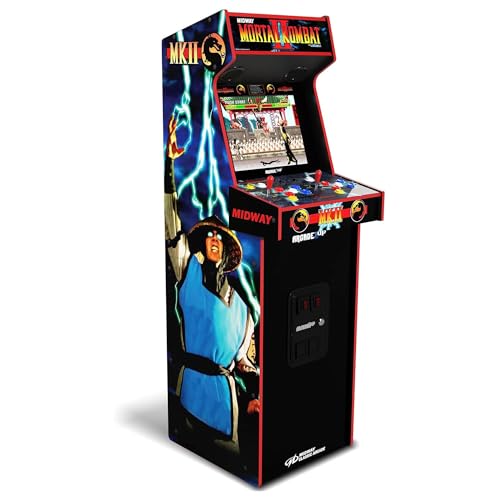
Arcade1Up Mortal Kombat II Deluxe Cabinet
A fighting game cabinet with the control layout the genre needs. Worth knowing that the stock joystick and buttons in this class are the weakest part, and that they are also the easiest thing to upgrade later with standard arcade parts.
Needs 3 ft 2 in x 7 ft
- Players
- 2
- Genre
- Fighting
Best for: A household that plays fighting games rather than dodging them.

UNICO MVSX Home Arcade with Riser
A bartop with a large curated library and a base and riser included, which puts it at standing height like a real cabinet. The library is the strength: fewer titles than a multicade and almost all of them worth playing, which is the opposite trade to a machine advertising thousands.
Needs 3 ft 2 in x 7 ft
- Format
- Bartop and riser
- Players
- 2
Best for: The best machine you can buy without going to a full size cabinet.

Doc and Pies Bartop Arcade Machine
Microswitched buttons and a proper joystick, which is the specification that separates a cabinet from a novelty and is exactly where machines in this price band usually economise. It sits on a counter, so it costs no floor space at all.
Needs A counter, no floor space
- Format
- Bartop
- Controls
- Microswitched
Best for: Someone who cares how the controls feel more than how the cabinet looks.
Prices move constantly, so confirm before you order. As an Amazon Associate we earn from qualifying purchases. Where a table is sold only through a manufacturer's own dealer network we say so on the card, and the button searches comparable tables you can order today rather than that exact model.
What each format actually is
| Format | Typical price | Floor needed | What it is really for |
|---|---|---|---|
| Countercade | $150 | A shelf | A novelty that gets played more than you expect. |
| Bartop, no base | $250 to $750 | A counter | Real controls without floor space. Needs a surface at the right height. |
| Bartop with base and riser | $550 to $950 | 3 ft 2 in x 7 ft | The best machine in this price band. |
| Home cabinet, 3/4 scale | $450 to $550 | 3 ft 2 in x 7 ft | Licensed artwork, child-friendly height, needs a riser for adults. |
| Full size four-player | $3,000 and up | 3 ft 10 in x 11 ft | The real thing. Out of scope for this page. |
The riser is not an accessory, it is the difference between a machine adults play and one they do not. A three quarter scale cabinet puts the control panel low enough that an adult plays hunched, which stops being fun after ten minutes. Ten to fourteen inches of riser brings it to roughly real arcade height. Some deluxe versions include one; if yours does not, buy the matching riser at the same time rather than later.
The controls, and upgrading them
Stock controls in this price band are the weakest component and the one most people notice. The joystick often uses a soft gate that makes diagonal inputs vague, and the buttons are frequently a moulded assembly rather than individual microswitches. On a fighting or shooting game that is the difference between the machine feeling like an arcade and feeling like a plastic toy.
The good news is that this is the most worthwhile and most achievable modification available. Standard arcade joysticks and buttons use common mounting dimensions, cost very little, and connect with spade terminals or a small encoder board. An afternoon of work transforms how a budget cabinet feels. It does mean opening the control panel and it does void the warranty, so the sensible order is to play the machine as delivered for a few months and upgrade if the controls are what is holding it back.
If you would rather not open anything, a MAYFLASH F300 arcade stick or an 8BitDo arcade stick gives you proper arcade controls on a console or a computer for around sixty to eighty dollars, which is a different way to solve the same problem.
Game count, and what it actually means
Machines in this band split into two philosophies. Licensed cabinets carry one game family, three to a dozen titles, chosen and properly presented. Multi-game machines carry hundreds or thousands of emulated titles including a great many regional variants and near-duplicates.
Neither is dishonest and the practical outcome is the same: you will play about twenty games. The licensed cabinets get the artwork, the marquee and the correct control layout for their genre. The multi-game machines get variety and the pleasure of finding something you had forgotten. The full argument is in dedicated cabinet against multicade.
Where it fits in a room
Anywhere, which is the point. A home cabinet needs about 3 ft 2 in by 7 ft including the zone the player stands in, and almost no side clearance because cabinets are built to stand shoulder to shoulder. That makes this the one game you can add to a room that is already full without moving anything else, and the reason arcade machines should be the last thing you plan and the first thing you add.
In a small room, a bartop on a counter costs no floor at all, which is why the small room buildout uses one. In a family room, a three quarter scale cabinet is genuinely an advantage because children can reach it, which is why the family buildout pairs one with a riser for the adults. Check the footprint against your own space with the arcade footprint planner.
Frequently asked questions
Are Arcade1Up cabinets worth it?
For a family room, yes, with clear expectations. They are roughly three quarter scale, the cabinet is lighter than a commercial machine, and the stock controls are the weakest component. What you get for around five hundred dollars is a licensed cabinet with the right artwork, a working screen and a machine that children can reach without a riser. Adults will want the riser. Anyone who cares deeply about control feel will want to upgrade the stick and buttons, which is a straightforward job with standard parts.
What is the best arcade machine under $1,000?
A bartop with a base and riser is the sweet spot, because it puts real arcade controls at standing height without the cost or footprint of a full size cabinet. Above that price you are into genuine full size four-player machines. Below about $300 you are buying a countercade or a novelty, which is a fine thing to buy as long as you know that is what it is.
How much space does a home arcade cabinet need?
About 3 ft 2 in by 7 ft including the zone the player stands in, which is genuinely a corner. Side clearance is almost nothing because cabinets are designed to stand shoulder to shoulder. That is the whole appeal of this category in a room that is already full: it is the one game you can add without moving anything else.
Do I need a riser for an Arcade1Up cabinet?
If adults are going to play, yes. The standard cabinet height in this class puts the control panel low enough that an adult plays hunched over, which is uncomfortable after ten minutes and is why so many of these machines stop getting used after the first month. A riser adds ten to fourteen inches and brings the panel to roughly the height of a real arcade cabinet. Some deluxe versions include one.
Can you upgrade the controls on a home arcade cabinet?
Yes, and it is the most worthwhile modification in this category. Standard arcade joysticks and buttons are inexpensive, use common mounting dimensions, and connect with simple spade terminals or a small encoder board. Swapping the stock stick and buttons for microswitched arcade parts transforms how a cabinet feels and costs a fraction of the machine. It does mean opening the control panel, which voids warranties.
Bartop or full cabinet for a small room?
Bartop, without much doubt. It occupies a surface rather than a floor, which is the cheapest square footage in a small room, and a good bartop with a riser and base ends up at standing height anyway. A full size cabinet is a better machine and it is a floor commitment that a small room usually cannot make, which is why the small room build on this site uses a bartop.
Measuring your own room before anything is delivered? The Game Room Layout Planner is the paid version of these pages: 8 printable worksheets you fill in with your own numbers, plus the full PDF, $29.
How we work: we compare published manufacturer dimensions, the governing playing standards for each game, and reviews from owners who live with the equipment. We do not test games in person, and we say so on every page. Clearance figures here are researched guidance for planning a room, not professional advice: measure your own space, and have a slate table delivered, assembled and levelled by an installer rather than moving it yourself.