Best Pool Cues for a Home Table, Including Short Cues
Buy four 58 in cues for a house table, in the fifteen to twenty five dollar per cue band where they are reliably straight. Add one 52 in short cue if any wall in the room came in tight. A 7 ft table with 58 in cues needs 13 ft 6 in by 16 ft 9 in, and 52 in cues reduce that to 12 ft 6 in by 15 ft 9 in.
Cues are the accessory where the sensible answer is unusually cheap and unusually specific: four house cues at fifteen to twenty five dollars each, plus one short cue if the room needs it. Almost nobody buying a first table needs anything more expensive, because the people who genuinely benefit from a two hundred dollar cue already own one and bring it with them.
The second purchase, and for many rooms the more important one, is a 52 in short cue . Almost every home room has one wall with a door, a column or a radiator inside the clearance band, and one short cue turns those shots from impossible into merely awkward for under sixty dollars. Check which of your walls has the problem with the room size calculator.
House cues and short cues

GARSEN Canadian Maple 58in Cue Set of 4
Four Canadian maple cues at roughly fourteen dollars each, which is the price point where a cue stops being a stick and starts being straight. House cues, not player cues, and that is exactly the right purchase for a table that four different people will use.
- Length
- 58 in
- Count
- 4
Best for: A first table, or a house table that guests handle.
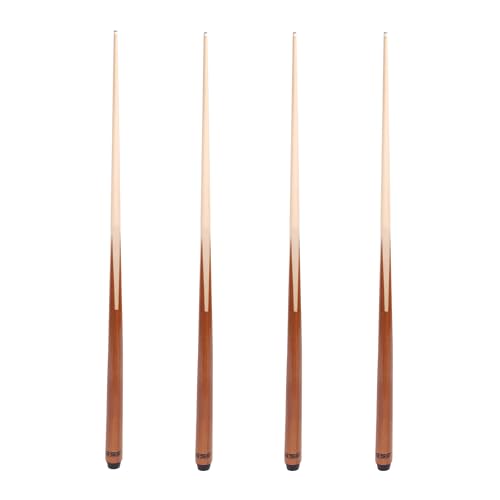
GSE 58in Canadian Maple Cue 4-Pack
The same idea executed better: proper ferrules, replaceable tips and a more consistent taper across the four. On a slate table these are the cues to have in the rack, because they do not embarrass the table and nobody panics when one gets leaned against a radiator.
- Length
- 58 in
- Count
- 4
Best for: A slate table that gets played several times a week.

ASKA 52in Short Pool Cue
One 52 in cue, which is the single most useful cue in most home rooms. Almost every room has one wall with a door, a column or a radiator in it, and this is what turns those shots from impossible into merely awkward. A mild compromise most players stop noticing within an evening.
- Length
- 52 in
- Type
- Short cue
Best for: Any room where one wall came in short. Which is most rooms.
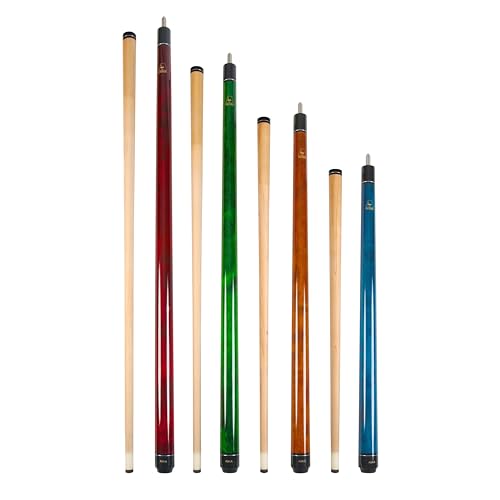
ASKA Short Cue Set of 4, 36 to 52in
Four cues at 36, 42, 48 and 52 inches. This is the honest answer for a genuinely tight room: play full length cues on the walls that measured fine and reach for a shorter one on the two or three shots per rack that need it, rather than playing the whole game short.
- Lengths
- 36 to 52 in
- Count
- 4
Best for: A room that failed the clearance test on more than one wall.
Prices move constantly, so confirm before you order. As an Amazon Associate we earn from qualifying purchases. Where a table is sold only through a manufacturer's own dealer network we say so on the card, and the button searches comparable tables you can order today rather than that exact model.
Cue length against the room it needs
This is the table that decides which cues to buy, and it is worth reading before choosing between a full set and a mixed one. Every figure is the minimum room measured from the outside of the cabinet to the nearest permanent obstruction.
| Cue | Room for a 7 ft table | Room for an 8 ft table | How it plays |
|---|---|---|---|
| 58 in, full length (standard) | 13 ft 6 in x 16 ft 9 in | 14 ft x 17 ft 8 in | The standard. What every league and tournament uses. |
| 52 in, short cue | 12 ft 6 in x 15 ft 9 in | 13 ft x 16 ft 8 in | A mild compromise most players stop noticing within an evening. |
| 48 in, short cue | 11 ft 10 in x 15 ft 1 in | 12 ft 4 in x 16 ft | Noticeably harder to keep straight. Fine for one wall. |
| 42 in, very short | 10 ft 10 in x 14 ft 1 in | 11 ft 4 in x 15 ft | Changes the stroke. A last resort for a specific corner. |
| 36 in, shorty | 9 ft 10 in x 13 ft 1 in | 10 ft 4 in x 14 ft | A child or a genuine emergency. Not a way to play a game. |
Every six inches off the cue buys back a foot of room in both directions, because the clearance is two cue lengths rather than one. That is why a short cue is the cheapest fix for a tight room by a wide margin: sixty dollars of cue does what dropping a whole table size does, and it is reversible.
What actually separates a cheap cue from a good one
- Straightness. The only thing that matters at house cue prices. Roll a cue on the table bed and watch the tip: it should not lift. Below about twelve dollars a cue this is a lottery, and above about fifteen it usually is not.
- The ferrule. The white collar behind the tip. On a good cue it is threaded or properly bonded; on a cheap one it is glued and works loose, at which point the cue is finished because the repair costs more than the cue.
- The tip. Leather, replaceable, and holding chalk. A flattened or mushroomed tip makes side spin unreliable and causes miscues, which is what people mistake for a table playing badly.
- Weight. Nineteen ounces is the common default and a reasonable middle for most adults. Heavier cues are steadier and slower; lighter ones are quicker and less forgiving. This is genuinely personal, which is why house sets are all the same weight and players who care buy their own.
- Joint and taper, above about eighty dollars. Real differences that a consistent player feels and a casual one does not. This is where the money goes on a personal cue and where it is wasted on a house cue.
Storage, which is not about tidiness
A cue leaning against a wall is being bent by its own weight, and it will take a permanent set within a season. Below grade, humidity accelerates it. Store cues vertically in a wall rack at under forty dollars or a floor stand at sixty five, and hold the room between 45 and 50 percent relative humidity with a dehumidifier if it is a basement. The combined cue rack and dartboard cabinet does both jobs on one wall if space is short.
What we would buy
- A slate table in a room that measured fine: four GSE maple cues and a wall rack. Done.
- A first table on a budget: four GARSEN maple cues , which cost less than sixty dollars for the set and are entirely adequate.
- One tight wall: add the 52 in ASKA .
- More than one tight wall: the ASKA four-length set , and read the small room roundup before ordering a table at all.
For everything else the table needs on day one, see the accessories roundup. For the balls, which are the higher-return purchase, see the ball roundup.
Deciding on a specific model? We review the ASKA short pool cue set of 4 review in full.
Frequently asked questions
What length pool cue should I buy?
Fifty eight inches is standard and what you should buy unless the room forces otherwise, because it is what every bar, league and tournament uses and it is what your stroke will calibrate to. The room decides the rest: a 7 ft table with 58 in cues needs 13 ft 6 in by 16 ft 9 in, and dropping to 52 in cues brings that down to 12 ft 6 in by 15 ft 9 in.
How many pool cues do I need?
Four is the sensible number for a house table, which is why cues are sold in sets of four. It covers doubles, it means nobody is waiting, and it gives you a spare when a tip goes. Add one short cue if any wall in the room came in tight. Beyond that, extra cues are storage rather than utility, because anyone who plays seriously enough to want a fifth cue already owns their own and brings it.
Are cheap pool cues any good?
Below about twelve dollars a cue, frequently not: they arrive with a visible bow, the ferrule is glued rather than threaded, and the tip mushrooms within weeks. Between fifteen and twenty five dollars a cue in a set of four, they are entirely adequate as house cues and that is the price band worth buying in. Above about eighty dollars a cue you are paying for joint construction, balance and shaft taper, which a serious player will notice and a casual one will not.
Do short cues really work?
For one or two cramped walls, yes. A 52 in cue is a mild compromise most players adapt to within an evening. A 48 in cue is noticeably harder to keep straight because the bridge hand and the grip hand move closer together, which amplifies any wobble. A 42 in cue changes the stroke entirely and nobody who plays regularly enjoys it. Treat short cues as a fix for specific walls, not as a plan for the whole room.
How do I stop pool cues warping?
Store them vertically in a rack, never leaning against a wall and never lying flat on a shelf for months. A cue leaning at an angle is being bent by its own weight, slowly and permanently. Below grade, humidity control matters as much as the rack: keep the room between 45 and 50 percent relative humidity and cues stay straight for years. A wall rack costs under forty dollars and a floor stand about sixty five.
When should I replace a cue tip?
When it goes flat, when it mushrooms out over the ferrule, or when it stops holding chalk. On a house cue in normal home use that is every year or two. A tip that has flattened out makes side spin unreliable and increases miscues, which is the point at which people conclude the table plays badly. A tip tool costs a few dollars and is usually in a basic accessory kit already.
Measuring your own room before anything is delivered? The Game Room Layout Planner is the paid version of these pages: 8 printable worksheets you fill in with your own numbers, plus the full PDF, $29.
How we work: we compare published manufacturer dimensions, the governing playing standards for each game, and reviews from owners who live with the equipment. We do not test games in person, and we say so on every page. Clearance figures here are researched guidance for planning a room, not professional advice: measure your own space, and have a slate table delivered, assembled and levelled by an installer rather than moving it yourself.