Best Pool Tables for Small Rooms
A 7 ft pool table needs 13 ft 6 in by 16 ft 9 in with a full 58 in cue, 12 ft 6 in by 15 ft 9 in with 52 in short cues, and 11 ft 10 in by 15 ft 1 in with 48 in cues. A 6 ft table with 42 in cues needs 10 ft 4 in by 13 ft 1 in. Before dropping table size, turn the table ninety degrees and try a short cue on the tight wall only.
Almost everyone reading this has already run their room through a calculator and got a number that does not work. The good news is that the number is not the end of the conversation: there are four levers, and they cost nothing, sixty dollars, a table size and a different game, in that order. The single most useful purchase on this page is not a table at all, it is a mixed-length short cue set .
If the room can keep a table set up permanently, skip the folding hardware and read the rest of this page instead: a fixed table at the same money is better in every way. Check your own space with the fit calculator, which tests both orientations and every cue length at once, before choosing anything here.
Small room picks, cheapest fix first

VEVOR 7ft Folding Portable Pool Table
A 7 ft table that folds and stores on its side, which is the only genuine answer for a room that has to do something else on weekdays. MDF bed, so the roll is approximate and the life is measured in years rather than decades. What it buys is a real table in a room that could not otherwise hold one at all.
Needs 12'6" x 15'9" with 52 in cues
- Bed
- MDF
- Size
- 7 ft
- Stores
- Folds upright
Best for: A room that is also a study, a garage that is also a garage, or a rental.

GoSports 7ft Pool Table, Wood Finish
A fixed 7 ft MDF table for the price of a sofa. In a small room the argument for MDF is stronger than usual, because the room is already a compromise and spending slate money on a compromised layout is the wrong order of priorities. Get the room right first, then upgrade the bed.
Needs 12'6" x 15'9" with 52 in cues
- Bed
- MDF
- Size
- 7 ft
- Install
- Self assembly
Best for: A tight room where you want to test the layout before committing to slate.

Legacy Baylor II 7ft Slate Pool Table
The smallest three-piece slate table that is genuinely a good table rather than a novelty. If the room measures out for a 7 ft with short cues on one or two walls, this is the one to buy, because slate in a tight room still plays properly while MDF in a tight room compounds two compromises.
Needs 13'6" x 16'9" with a full cue
- Bed
- 3-piece slate
- Size
- 7 ft
- Install
- Professional
Best for: A room that measured tight but not impossible, and a household that will keep the table.

Plank & Hide Isaac 7ft Slate Pool Table
A more common combination than it sounds: the room only takes 7 ft and the budget does not have to stop at the mid tier. The money buys cabinet quality, finish and cushions rather than size. Do not expect it to play like a bigger table. Expect it to be an excellent small one.
Needs 13'6" x 16'9" with a full cue
- Bed
- Slate
- Size
- 7 ft
- Finish
- Black ash
Best for: A finished room where the table has to look right and the size is fixed.
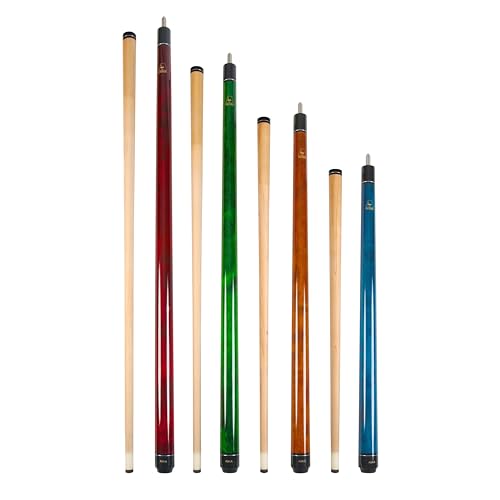
ASKA Short Cue Set of 4, 36 to 52in
Four cues at 36, 42, 48 and 52 inches in one box. This is the single most useful purchase on this page, and it costs less than a tenth of any table here: it lets you play a full length cue on the three good walls and reach for a shorter one only on the two or three shots per rack that need it.
- Lengths
- 36 to 52 in
- Count
- 4 cues
Best for: Any room where one wall came in short. Which is most rooms.

Atomic Classic Bumper Pool Table
Bumper pool is played from all sides with short cues on a 54 in octagon, so the clearance requirement collapses compared with a rectangular table. It is a different game rather than small pool, and it is a good one. This is the honest answer for a room that fails even the 6 ft with 42 in cues test.
- Shape
- 54 in octagon
- Cues
- Short, supplied
Best for: A room under about 11 ft in its shorter dimension.
Prices move constantly, so confirm before you order. As an Amazon Associate we earn from qualifying purchases. Where a table is sold only through a manufacturer's own dealer network we say so on the card, and the button searches comparable tables you can order today rather than that exact model.
The full small room clearance matrix
Width first, then length, measured to the nearest permanent obstruction rather than to the wall behind it. These figures are measured from the outside of the cabinet, not from the cloth, which is why they run six to eight inches larger than the optimistic charts.
| Table | Playing surface | 58 in | 52 in | 48 in | 42 in | 36 in |
|---|---|---|---|---|---|---|
| 6 ft (bar box, compact) | 33" x 66" | 13'0" x 15'9" | 12'0" x 14'9" | 11'4" x 14'1" | 10'4" x 13'1" | 9'4" x 12'1" |
| 7 ft (bar box) | 39" x 78" | 13'6" x 16'9" | 12'6" x 15'9" | 11'10" x 15'1" | 10'10" x 14'1" | 9'10" x 13'1" |
The four levers, in order of cost
- Turn the table ninety degrees. Free. Most rooms are not square, and most people default to placing the table lengthwise along the longest wall without testing the alternative. A room of 12 by 17 ft fails a 7 ft table one way and passes it the other. This rescues more rooms than everything below it combined.
- Move one obstruction. Usually free. Very often the problem is a single radiator, a shelving unit, or a door that swings the wrong way, rather than the room itself. Measure to the obstruction, then ask honestly whether it has to be there. A doorway that swings away and that nobody stands in does not count against you at all, because a cue can extend through an open door.
- Short cue on the tight side only. About $60. The ASKA four-length set covers 36 to 52 inches in one box, and the single 52 in ASKA is what most people actually reach for. Twelve inches of clearance recovered in both directions for less than the cost of a ball set.
- Drop a table size. $500 to $2,000 of difference. Going from 7 ft to 6 ft buys back six inches of width and twelve of length. Be clear-eyed: a 6 ft table is not a competitive table, the pockets play very differently, and it is the last lever rather than the first for good reason.
Where slate still makes sense in a tight room
There is a common instinct that a compromised room deserves a compromised table, and it is backwards for one reason. A tight room already costs you shot selection. Adding an MDF bed costs you the roll as well, and the two compromises compound: on a drifting bed in a cramped room, a long shot you had to play awkwardly also does not go where you aimed it.
If the room measured out for a 7 ft table with a full cue on two or three walls and a short cue on the fourth, buy slate. The Baylor II is the buy-once pick, and the Empire Dakota 7 ft sits alongside it with different cabinet styling and near-identical play. Both need professional delivery and levelling at $300 to $600, which is covered in what installation costs.
If the room only works with 48 in cues on more than one wall, MDF becomes the rational choice, because at that point the layout is the limiting factor and spending slate money on it is the wrong order of priorities. Buy the GoSports 7 ft and spend the difference on the light and the flooring, both of which you keep.
When pool is the wrong game for the room
There is a real threshold below which no table and no cue makes a rectangular pool table work, and it is roughly a room whose shorter dimension is under 11 ft. Past that point the honest advice is a different anchor game, and the alternatives are genuinely good rather than consolation prizes.
- Bumper pool is played from all sides on a 54 in octagon with short cues supplied, so the clearance requirement collapses. The Atomic Classic and the slate Hathaway Renegade are the two worth considering. See the bumper pool roundup.
- Foosball is the largest genuinely serious game that fits a tight room, because the players stand still. The Hathaway Primo is the value pick. See the foosball roundup.
- Darts is the highest value per square foot in the hobby and needs a wall rather than a floor. See the dartboard roundup.
- Shuffleboard wants a long narrow run rather than a wide band, so a room that is thin and long will take a 9 or 12 ft board while refusing a pool table outright. See the shuffleboard roundup.
The complete list, with the floor area every anchor game needs side by side, is in how much space each game needs, and the small room buildout prices a complete room around games that fit rather than games that nearly fit.
Ceiling height, which small rooms also fail
A tight room is frequently a low room, and the two problems are separate. A pendant over a pool table wants 8 ft of ceiling: the bed sits about 31 in up, the shade hangs 30 to 36 in above the cloth, and you still need to lift a cue butt on a rail shot. With a flush or recessed fixture instead you can work at 7 ft 6 in, at the cost of shadow control across the cloth. Use two rows of recessed cans either side of the table rather than one row down the middle, which is what recovers most of what the pendant would have given you. Full figures in the ceiling height chart.
Deciding on a specific model? We review the GoSports 7 ft pool table review and ASKA short pool cue set of 4 review in full.
Frequently asked questions
What is the smallest room for a pool table?
With a full 58 in cue a 7 ft table needs 13 ft 6 in by 16 ft 9 in. Dropping to 52 in short cues brings that to 12 ft 6 in by 15 ft 9 in, and 48 in cues bring it to 11 ft 10 in by 15 ft 1 in. A 6 ft table with 42 in cues needs 10 ft 4 in by 13 ft 1 in, which genuinely does fit some spare bedrooms. Below that, a rectangular pool table is the wrong game and bumper pool or another anchor is the right one.
Are short pool cues any good?
For one or two cramped walls, yes. As a whole-room strategy, no. A 52 in cue is a mild compromise most players stop noticing within an evening. A 48 in cue is noticeably harder to keep straight because the bridge and the grip move closer together. A 42 in cue changes the stroke entirely. The right approach is a mixed set: full length cues for the walls that measured fine and one short cue for the wall with the door or the column in it.
Should I buy a smaller table or use shorter cues?
Shorter cues first, because they are reversible and cost under sixty dollars. Going from a 7 ft to a 6 ft table buys back six inches of width and twelve inches of length, while going from a 58 in to a 52 in cue buys back twelve inches in both directions. The cue does more, costs less and can be undone. Only drop table size when the cue change is not enough, because a 6 ft table plays a genuinely different and less satisfying game.
Does turning the table really help?
More than anything else on this page, and it is free. Most rooms are not square, and most people place a table lengthwise along the longest wall without ever testing the other orientation. A room of 12 by 17 ft fails a 7 ft table one way and passes it the other. Test both before spending anything at all: the fit calculator on this site does it automatically, including with every cue length.
Can I put a pool table against a wall?
Physically yes, practically no. A ball freezes against a cushion several times a rack, and the shot down that rail is the one that decides games. A table against a wall means that shot is played by jacking the cue butt into the air, which is how people miscue and tear cloth. If one side genuinely has to be tight, make it a side rather than an end, and keep a short cue on that side.
Is a folding pool table worth buying?
In one specific case: a room that has to be something else on weekdays. A folding table stores on its side against a wall, which no other table on this page does, and that is worth a real compromise in the bed and the cushions. In a room that can keep a table set up permanently, a fixed MDF table at the same price is better in every way, because folding hardware is one more thing that goes out of true.
Measuring your own room before anything is delivered? The Game Room Layout Planner is the paid version of these pages: 8 printable worksheets you fill in with your own numbers, plus the full PDF, $29.
How we work: we compare published manufacturer dimensions, the governing playing standards for each game, and reviews from owners who live with the equipment. We do not test games in person, and we say so on every page. Clearance figures here are researched guidance for planning a room, not professional advice: measure your own space, and have a slate table delivered, assembled and levelled by an installer rather than moving it yourself.